Wednesday, July 28, 2010

Violence Against Women

Lately there have been several different works that call attention to violence against women in our contemporary world. I will mention them in order of my encounter with them

First is of course Stieg Larsson's The Girl with the Dragon Tattoo,( original title, Men Who Hate Women)  and The Girl Who Played with Fire ( I haven't read the third one yet). These two books describe  a lot of violence against women, but there is also the fabulous heroine tough Lisbeth Salander, who has survived unspeakable violence against herself and is on a virtual crusade to punish those who perpetrate the violence. And we cheer her successes even though her methods are also violent because of the violence of her opponents. As a second theme, that relates to violence against women, the books are also a send up of the profession of journalism and the use of mindless sensationalizing smears.

The second forum for addressing violence against women is the play Ruined by Lynn Nottage. I have actually seen it twice, in London and in Seattle in a production by the Intiman Theater. The Seattle production was the original NYC cast and director. The night I went we had the understudy Victoire Charles, who was fantastically good in the lead part which required a huge range of emotions from sassy, sexy, and strong, to terrified and finally, happy (the hardest part to make believable).

Both productions confronted us with the position of women caught in the midst of meaningless war, guerilla conflicts, and their limited choices for survival.
1 be tough, tough, tough.
2 prostitution is preferable to sex slavery and rape
3. children are sacrificed toother people's violent desires
4 traditional society's perceptions of the position of women and contemporary war's utter disregard of respect for women are a terrible mismatch
The women of the cast were fantastically good, different types, different experiences, all of them riveting us with their personal stories. The stories are real, they are based on interviews that the playwright conducted by women from the Congo. The men of the cast seem more types, than individuals, but there were a lot of types within the general theme of guerillas, traders, and commandoes. There was one sensitive man, but each one had a range of strong feelings.
Then there is that other less emphasized theme, that the meaningless war was being waged today in the Congo for the rare minerals that go into all of our electronic gadgets. So as with the BP oil spill we are all implicated.

In partnership with the play Ruined  we went to see the movie Call and Response at the Northwest Film Forum, sponsored by Seattle Against Slavery. The film was bascially a documentary about a Concert to End Slavery, organized by Justin Dillon who is interviewed about how he came to do the concert. He includes amazing musicians like Emmanual Jal who survived being a boy soldier, Imogen Heap, Natasha Beddingfeld, and Dillon himself, Talib Kweli, and interviews with Ashley Judd, and the actress Julia Ormond as well as Nicholas Kristoff and others. It also included facts like there have one million people enslaved in the US in the last ten years and only 50 convictions. That there are17,000 people in sex slavery today, it is the single most lucrative enterprise (but Ormond pointed out the continuous flow between guns, war, drugs and slavery).
The magnitude of the problem is staggering. Everything we buy is probably touched by slave labor. This is sex trade that is getting younger and younger, we saw children of six or seven offering sex services. We saw the drug induced prisons for women sold out of villages for tiny debts, but we also heard from people who are trying to help people to get out.
All these media, novels, theater, film, music, addressed the same problems, the same issues. Collectively they are overwhelming. But there are many groups working on doing something, the meaning of the title of the film is here is the call, let us all respond.


Friday, July 23, 2010

Art Sparks Occidental Square Summer 2010

My office is on Occidental Square, and so I am familiar with all the regular people who like to spend the day there. They sit on benches pursuing various activities. They are guarded by the wonderful 1970s totems by indigenous carver Duane Pasco one of which you see in this photograph.


So I was surprised one day to suddenly see a red carpet rolled out and a women in ornate Victorian dress standing there.
It was Art Sparks, a program sponsored by 4 Culture
(whom I just highlighted in the previous entry). They have commissioned artists to come to Occidental Square all summer and spark it, that means, bring art to the parks that interacts with the public, and creates a more friendly setting for passersby.

The red carpet and the woman in Victorian dress, I learned, were part of that project.
It was AK Mimi Allin.

She was reading War and Peace in her period costume, as she walked up and down the carpet, and we were invited to accompany her for a round trip as she read. So I did. Twice. It was fun. The first time I was asked to hold her parasol, as she read a passage from early in the book, before the war takes hold. The second time, we were out on the battlefield dealing with problems.
I asked her about the project and she said she liked to take on challenges, like a very long book that we have difficulty reading these days.
She was there a whole week, every day, reading, sometimes alone, sometimes with other people keeping her company.
I went from dubious to enthusastic. I love books. Her perseverence and good humor won me over. I found her reading on a break in the Grand Central Building and she was really into the book. I asked her for my friend John at the Globe Bookstore which edition she was reading, and it was the latest. (The Globe Bookstore doesn't have a website.  Go and discover for yourself on First and Main, now that Elliott Books is gone, it is a treasure that is to be relished all the more!)

So it was a great project.
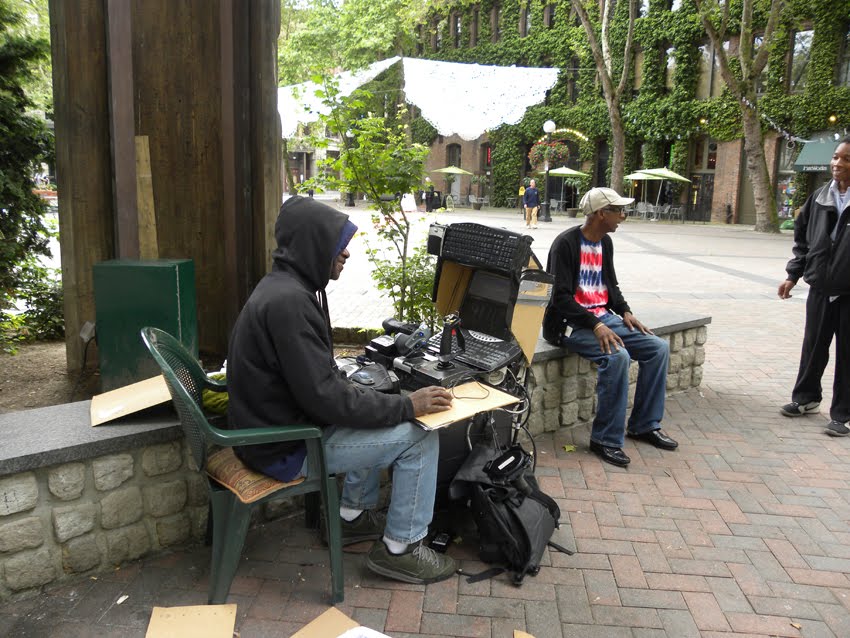
Right next to her in the park was Tony.
Tony had brought his hobby to the park. It was a flight simulator. He said it was what pilots do to learn how to fly. He had a lot of equipment and he enjoyed showing me how it worked. But of course he wasn't part of Art Sparks. He was just there because it was a sunny day.
Then there was the canopy by Celeste Cooning, which was part of Art Sparks. It is
hanging in the trees. It is adding to the tree canopy. It is called Celebration and Fanfare. It is made of a "paper like plastic fiber" and hangs over our heads as we pass under it. It is delicate and casts shadows like the trees. I'll let you decide what you think. It probably appeals to a lot of people who like their art attractive.

Another group called City Meditation Crew, from NYC I think,  made a meditation circle with reflective gum wrappers. They were wearing white costumes with big white hats. They definately stood out from the rest of us mortals. They created events including a walking mediation that called attention to daily living. (I couldn't stay for their events, but I thought about them as I passed by with my daily living) There was also a Butoh performance that I didn't see. There are other events coming up, listed on the website
There have been some other art events in the city outside the box. One important performance was by Garric Simonsen. This cart was part of his performance in which he wheeled a cart full of delectable inflatable toys and stuffed animals through the city from the James Washington Foundation  which sponsored him as part of a residency. He walked from the Washington Foundation in the Central District, down Capitol Hill, and all the way to Occidental Square. He gave away all the toys on the cart and on the way he had a lot of great conversations with the public and a lot of fun. Simonsen and all the artists in residence at the Washington House are inspired by the spirit of James Washington. They respond to this famous sculptor's home and legacy in many different ways as they work in his studio. Simonsen responded to Washington's big commitment to children, community, and public engagement. He transformed that into his own exploration of issues that artists face about how to interact with the commercial systems of art (which he was obviously subverting here in a number of ways.) Washington was really brilliant at promoting himself by the way.

So how does one evaluate these type of art expressions? By whether some members of the public respond, then they all worked, by whether the public space is enlivened, that also happened. But still I am struck by the fact that Mimi was so much more really there than some of the other projects sponsored by Art Sparks, even though she had a red carpet and a Victorian dress. We could all walk with her.

I also really like the artists like Tony and Garric who just do their own thing out there.
And don't forget all those permanent residents many of whom are pretty interesting in their own right. I introduced my one year old granddaughter to my personal friends among the permanent people the other day and they were all delighted to meet her.
Here she is with me camping at Mt Rainier. I didn't catch the downtown greetings on camera.

Detained

Here in the Northwest we still have a lot of support for art from the public sphere, King County 4Culture, the City of Seattle Mayor's Office of Art and Cultural Affairs, the  Washington State Arts Commission. There are also many local non profits that support both visual art and the literary arts, theater, dance, opera, music and much more. Then we have street festivals, farmers markets, and impromptu creativity. We are lucky here.

But from my own perspective, I was really excited about an exhibition that is taking place at 4Culture gallery this summer, because the public support does not often, for obvious reasons, translate into support for politically engaged art. Sometimes there are subtle and indirect environmental references, and there has been a lot of support for artists working in the environment, but hard politics is a hard sell.

Eroyn Franklin managed to break through that with her amazing series "Detained."
Her drawings fill the walls of 4 culture with the stories of two immigrants going through detention centers in Washington State, the Northwest Detention Center in Tacoma, and its predecessor in Seattle, the U.S. immigration and detention facility.  It includes crucial, specific details, it makes the vague information that we have about detainees visible.

She tells two stories. One man from Cambodia, Many Uch,  who came here as a child, was placed in detention as an adult because he drove a getaway car in an armed robbery when he was 18, a crime for which he had already served a sentence. A woman, Gabriella Cubillos, was detained because she was pulled over for expired tabs, detained for unpaid parking tickets: she had entered the country illegally many years ago, when it was common and easy in the 1990s. 
Eroyn had some important facts that don't appear in the drawings with their thought balloons about conversations among inmates in the centers or elsewhere ( above in a mosque after Mani was released)

2/3 of deportees are removed for immigration violations alone
90 percent have no legal representation, no timely hearings
80 percent of those detained are deported- they say they want to be deported in order to get out of detention
Immigrant law is different from criminal law
All immigration decisions are part of the Executive branch, there is no legislative involvement

The growth in this industry is huge: the old INS in Seattle had 200 beds, ICE in Tacoma had 1000 when it opened, and it has 1545 now. There is a lot of money available for this since 9/11. In 2008 there was a 35 percent increase in deportations to more than 10,000 people ! This is horrendous. Detentions are random ( often combed from prison populations), there is virtually no legal recourse, and many of the people deported have made their homes in the US for many years and have children here.
The injustice of the situation is blatent.
What has happened to this country, formerly so welcoming to immigrants and enriched by them.
Of the 16 detention centers in the US, 7 are run by private contractor GEO,
they make $150 on every person in the center.  It is seen as an "investment opportunity" and a "growth industry" Another facility is projected for Yakima.

I would like to add from the Bill of Rights Defense Committee site that the Bureau of Immigration and Customs Enforcement ( ICE) spends 1.7 billion a year to detain 380,000 people

How did Franklin pull off having he"Detained" shown at 4Culture?
Well she is a photography graduate of Paul Berger and the University of Washington. That is a very helpful credential in this city.

Also, she was working with a journalism group who have done special reporting on this issue called The Common Language Project. They have done a four part series called Between Worlds/Behind Bars on "Seattle's Ellis Island" on the Northwest Detention Center in downtown Tacoma. So she had content that resonates, a crucial factor. She is engaged with her subject.

Finally, the work is difficult to read, as you can see from the image above. The fifty foot long drawings require serious effort for a gallery goer accustomed to sweep through a show at a glance. That makes it less obviously threatening to people who don't bother to read it. The writing is small for a gallery, it will be much easier when the book comes out. Here is the newspaper image.

PS. The old Seattle INS facility has just been sold online to investors who will work with the International District residents to address itthe history of immigration in Seattle which goes back to the detention of the Chinese in the late 19th century.

Tuesday, July 13, 2010

Shirin Neshat Women without Men

I just saw Shirin Neshat's first feature length film, Women without Men, 2009. It has won a lot of awards, at the Sundance Film Festival, at the Venice Biennale, and elsewhere.

I wonder how many of the people giving awards and writing reviews have read the novel by Shahrnush Parsipur of the same title. This is the second novel by Shahrhush Parsipur that Neshat has used as a point of departure, the first was Touba and the Meaning of Night.

Parsipur seems to be supportive of the film, she is appearing in the photographs of the Silver Lion ceremony in Venice and she even plays a part in the film as the brothel madam.

The film is visually dazzling, Neshat's trademark, and her film is a logical direction from her early photographs, then the slow moving imagery of her installations, to now a feature- length film. Her husband Shoja Azari is also a filmmaker and collaborates with her. The film was shot in Morocco, with Casablanca as 1950s Tehran. This is a good review.

Women of Allah, her famous photography series in which she wrote the poetry of  the famous modernist Iranian feminist poet, Forough Farokhzad, on the hands and face of (herself) wearing a chador, was a response to a visit to Iran after many years. She was shocked at the changes from what she remembered in the late 1970s as a small child ( she left in 1979 at the time of the Islamic Revolution). Paying homage to a great poet as a visual artist is common in art from Iran, Iraq, Egypt, and other countries in which poetry has been more important than visual art. (I would like to avoid the inaccurate term "Middle East")

Her film Women without Men appeared almost at the same time as the Green Revolution, an amazingly fortuitous circumstance for its success. The cast and Neshat wore green and held up the peace symbol in Venice during the award ceremony in September 2009 for Best Director.

The film is pure Shirin Neshat. She has stunning  images of women in black chadors (she has a love hate relationship with chadors, she loves their visual effects, but not the oppression of wearing them.) A lot of her films include an emphasis on the black shapes of the chador.
I have heard Shirin Neshat speak, and she is very compelling. I can still remember her saying on a panel in Istanbul, " artists in Iran do not have the luxury to ignore politics."

On that note, the film's vortex is the politics surrounding the US coup of 1953 which overthrew a democratically elected government in Iran and reinstalled the Shah.
One of her characters, Munis, comes back from death and engages with the political activists who support Mohammed Mossadegh. They are represented as Communists, leafleting in the dark of night, resisting the supporters of the Shah in demonstrations in the streets.They are ultimately crushed both literally and metaphorically. That's Munis in the photograph above, floating in a sea of people, both there and not there ( she is after all resurrected from the dead.)

None of this is in the novel.
The sole reference to the coup in the novel is the date of the novel mentioned in the book, August 1953. There is unexplained turmoil in the streets. Munis is not a political activist, she simply visits a bookstore and reads some books.

Parsipur is a feminist novelist, she has been writing books and short stories since the late 1960s. Women Without Men was first drafted in the late 1970s, although published in the late 1980s. She was censored for referring to virginity and has spent time in jail. Her life has been both as an acclaimed Iranian novelist and as an exile since 1994 whose works are banned in Iran, an incredible tension. All of her novels include elements of the magical, the incredible, magic trees, magic women, women as trees,  ( if you saw Touba by Neshat, the woman became the magical tree, in her novel Women without Men, a woman plants herself and becomes a tree).

But the main theme of Women without Men, the novel, is women together in a special place. In that place, a house with an orchard, magical events occur. The novel is feminist, focusing on four women from different social classes, a prostitute, a sister of a repressive and religious brother, a religiously observant woman in love with that brother, and a wealthy woman who leaves her general husband and buys a garden and estate in the country in order to be free and do as she wishes, including writing poetry, which she does badly. ( In the film she is a singer).

The main theme of Women without Men the film, is the coup d'etat, the role of the United States, and people's lives at that time. Neshat brings together the military, the Shah reinstatement, and the magical orchard where the women live by having the military who are searching for communists after the Coup come to a party at the house in the orchard.

The parties in the book are not connected to the military, they are a celebration of life and the aspirations of Fakhri to be famous. In the film, she is attached like a mother to the prostitute Zarin who hovers between life and death;  in the book, Zarin marries the gardner and has a magical pregnancy ( becoming transparent), giving birth to a lily which is planted by the stream. Her mothers milk is given to the woman tree.

The place of music is crucial to the film. As the soldiers and officers sit at the table disrupting the party of the bourgeois guests who both support and do not support the coup, the tension is broken by the beautiful singing and playing of an elderly man. (earlier, before the soldiers arrived, the hostess Fakhri had performed herself).

So the question is what is the position of culture here?  I found it provocative, on the one hand it was soothing the oppressive military men, on the other hand it was disrupting their oppression.

The other question is, why did Neshat keep the same title as the novel for her book. Her film is about the tension between life and politics, between freedom and oppression, the novel is about complex relationships between women, between reality and fantasy. They are entirely different. In the book all four women are in the same place. Munis does not go back to Tehran.

But one cannot argue with Neshat's power to call attention to political issues in an aesthetic context. This is the most difficult achievement for art. I salute her for that. But for those who are looking for an Iranian film, they will have to look elsewhere. She has said she wants to convey the complexity of Islamic culture, but contemporary Iranian women say that she has been away too long ( she is also banned from Iran now). Iranian women that I know do not like her work. They find it annoyingly cliched and superficial with respect to Iranian society and Iranian women.They refer to her art as "chador" art, or "veil" art, holding the Western gaze to Eastern art.


I suggest Bidoun magazine, an outrageously amusing and clever contemporary publication on culture in the Middle East (they call it that) and Arteeast, an online journal that has indepth articles on a range of subjects.

Nonetheless, Neshat is the primary female Western-based artist who is so prominently addressing Iranian politics in art for the international art audience.  At least she is opening the door. The fact that we think all those chadors are what is happening in Iran then or now just shows how much we all have to learn.

Saturday, June 19, 2010

Provence then and now


In our trip to France, we visited St. Remy (the asylum where Van Gogh painted some extraordinary artworks), this is the view out of his window from his tiny room. It is my perverse nature to begin our trip with a view of his barred bedroom.  The olive trees look just like his paintings.
The asylum continues in use today, and there was a mural created by children living there. I guess having had a really famous artist living there must be an inspiration to them.

Aix en Provence (Cezanne's home Jas de Bouffan, Cezanne's studio, and Cezanne's quarry, Bibemus) - Here's Henry in the quarry listening to the guide who told us the geology, the art history, and the history of the quarry. Just after this we turned around and saw Mont St. Victoire  as Cezanne saw it.

Vallauris and Castle Grimaldi (Picasso), here is a sample pot by Picasso, no pictures allowed in most places, but I got this one in Vallauris. The sculpture is in a nearby plaza.
There were amazing contemporary artists working in ceramics also.


The Maeght Foundation (modern art especially Miro), here is a sample. Below is the facade with a mosaic by Chagall. Miro's work pays homage to the farmers who were still working there in the 1960s. He had an entire sculpture garden of work that needs a separate entry or a slide show. Braque had a tiled pool and stained glass. Every art work suggested new perspectives on old friends.


The Vence Chapel (Matisse), entrance, amazing stain glass inside


The Matisse Museum in Nice with joie de vivre, Sunday afternoon in France in the foreground.


The Museum of Prehistory (wonderful website, you have to search for it in French Musee Prehistoire so here's a link) in out of the way Quinson, Verdon. We were so lucky to get in with the school children with my press pass, since it is closed on Tuesdays, the day we showed up. It was a high point of the trip for me. Interactive educational displays and state of the art media. They took us through the stages of human development based on a cave discovered nearby with remnants of human life starting 700,000 years ago. The stunning museum was designed by Norman Foster. The school children in France are studying evolution.  Here is also the earliest example of stone carving that they found in the cave.


This was near the gorge of Verdon that we hiked in
and the exquisitely beautiful town of Moustiere Ste Marie recommended by my good friend Romson Bustillo. Here is my salute to the good life in a small restaurant there.


The Museum of Resistance in La Fontaine de Vaucluse, called Call to Liberty 1939 -45 told the story of Petain's capitulation to the Nazis, his cult, his sending of French men to work in German industries, and then the amazing resistance movement with its multiple identities, courageous participants, and its successes (sabotage) and failures (killing and persecution). It had a whole section on the artists in the resistance, especially writers, like Paul Eluard.
One poet memorized 140 poems while in prison and then wrote them down when he got out.


In Avignon there was a national strike in France and a great March in the main street ending at the Papal Palace. Of course that was another high point.The French socialists had the best chants and were thrilled to meet an American socialist ( that's me)  they didn't know there were any. The French were protesting the threatened cuts in benefits and pensions because of the economic crisis. Of course my personal ( absolutely unverified and unverifable) theory is that the privatization people wanted to force Europe to stop giving all those services, and the crash was a great way to force them into it.


Seeing the art of these famous artists in the locations where they lived and worked was enlightening. (We missed out on Leger, that will have to be on the next trip).

They moved to Southern France when it was dirt cheap, one after the other, Cezanne came from there and never left, and he painted in his own back garden as well as a quarry and his studio. Amazingly limited geography. He was forced to the sea during the Franco Prussian war and painted the Meditaerranean "l'Estaque" like a big blue wall. No crashing waves for him. Van Gogh of course moved for the sun and color.

Matisse in Nice were a perfect match of light and color, Picasso went there in 1946 (having spent the war years in Paris) and spent three months painting with makeshift materials at the Grimaldi Castle. It is now a Picasso Museum right on the water, in what was a grim old castle. Today it is filled with light and air and an extraordinary group of paintings, many of them in tones of grey and brown.There is also a stunning group of black and white photographs of Picasso painting in the Palace, with Francois Gilot, the only woman who every left Picasso, from those same months.  And then there is Picasso's amazing pottery. He painted on preexisting pots in Vallauris and restarted the entire pottery production there.

Apparently he didn't like the fact that Matisse made a chapel for nuns at Vence. He was an atheist, but a very competitive one, so he did a chapel in Vallauris with War on one wall and Peace on the other wall. It has been closed down though. Here is War. Peace will come soon. Below is a photograph of the Chapel from the web. The murals are painted in a Romanesque chapel with a barrel vault and he painted it completely. Of course the formalists don't like any of Picasso's political work.
I've never even see these work reproduced before. Not part of the MOMA canon, that's for sure.

And then there is the Maeght Foundation. We went there on a perfect Sunday morning, blue sky, sun, green grass, the building designed by Jose Sert, the unity of artists, site, and spirit was perfect. Aime Maeght was close friends with the artists represented here, he supported them right after the war and they supported his museum. There is a unity of place, persons, art that is rare in the art world. It belongs to a lost time, the 1940s - 1960s, before the Cote D'Azur went crazy and became what it is today, a rich person's play ground.


We managed to find one tiny beach S Juan des Pins, that was public and had a picnic and took a quick swim. Apparently that is where the famous photograph of Picasso holding the umbrella over Francois Gilot was taken.


I didn't know that Matisse moved to Vence during the war, after the Germans occupied Southern France, or that his daughter was tortured by the Gestapo. I didn't know that the Resistance was centered in Provence because of the rugged countryside or that the US Allies bombed Avignon killing many civilians, in order to prepare for the invasion of France (sound familiar? ). I also didn't know that Picasso had lived in Aix following the footsteps of Cezanne and ended his life near Avignon. Right to the end he was soaking up other artists work. Matisse was always the man of pleasure that Picasso could never emulate, his line he said was "a description of the states of the soul". Picasso was always striving, stretching, and creating big failures as well as big successes. 

 His "three keys of Antibe" painted in pale gray on the wall of the Grimaldi Palace is simple mystery, perhaps a magic charm. I was not able to photograph it, but I did draw it. Maybe I can scan that.

I am on the emotional side with Picasso, but I can still enjoy Matisse. Cezanne I felt was so priviledged, how could he fail to be a success. All he had to do was paint!
There will be  more pictures soon. Here we are reflected in the water from the famous Avignon Bridge


Monday, June 14, 2010

Henry Moore, Steve McQueen, "War and the Body" and "War Horse"


This shadowy photograph shows a sculpture by Henry Moore at the Tate Britain. It is in the permanent collection, not part of their new exhibition of Moore's sculpture. It represents a sculpture based on one of the shelter drawings from World War II, with its flowing robe and awkward pose, it has been pulled from the many drawings he made in the London Underground and other shelters during the Blitz.


There was footage in the Tate show of Moore actually walking through the tube underground stations. He explained that he only drew people afterward and usually sleeping as he did not want to be too invasive. I didn't realize that these famous drawings in the London Underground depicted sleepers on the platforms ( of course they did, if you think about it) and that the people there were in non sanctioned shelters. They just went there in droves. After the fact, the government sanctioned it as a shelter.
Moore commented (and this explains some of the drawings), "the only thing at all like those shelters that I could think of was the hold of a slave ship." You see emaciated cadavers in facing rows and close up couples. Moore found that their gestures while asleep told him a lot about their state of mind. He also found the sight "pathetic, sordid and disheartening." According to the museum though, he "transformed London's poor into heroic figures and the uncertainty of their situation into stoic resignation. "

One of the most fascinating details in the exhibition were his sketches of preliminary ideas for drawings ( he was commissioned by the government to paint the war). In his tiny sketches he drew burning cows, and sheep with airplanes flying overhead. How rarely we see the impact of war on animals.

The heart of the exhibition was the war period. His drawings of miners in the same time frame, commissioned by the War Artists Advisory Board, are equally strong (his father was a miner), suggesting claustrophobia, as well as courage and perseverence under incredibly difficult conditions deep inside of mines.

The framing of Moore by the Tate aside from this section which cut through their efforts like a knife, was to focus on sexuality, surrealism, modernism and materials. The exhibition brochure was organized by medium, a particular stone, a specific wood, etc.
I went through the exhibition with my inlaws who had been to Moore's studio with the artist. He felt that touching the sculpture was crucial to understanding it, but of course in the musuem, the materials were simply an aesthetic reference, not a tactile experience.

The gallery materials gave us no biography (such as his roots in working class England), and only cursory references to his exploration of other art forms such as Egyptian and Meso American (which the museum calls Ancient Mexico  "dominated by sex and religion).  It mentioned the importance of Roger Fry's book Vision and Design, without saying when it was published (1920) and included some wonderful sketches.

Moore's art and his own words trumped their efforts. For example he said " Trunks of trees are very human. To me they have a connection with human life." So from a material, wood became an active spiritual presence.

Steve McQueen's "Queen and Country" at the National Portrait Gallery is a very different type of art about war, also commissioned by the government.  He has been on a long campaign with Royal Mail to get these stamps used on letters. He has created 160 sheets of stamps, each stamp with a single face of someone who has died in Iraq in 168 stamps.

Steve McQueen is part of a long tradition in England, the official war artist. He went to Iraq in 2003 to try to make a piece but was barely able to leave his room. That's when he thought of stamps. But Royal Mail and the Ministry of Defense have been very difficult to deal with in creating the project, he couldn't get the addresses of soldiers who had died. And this article raises the question of how such a project would be received in the US where even photographs of flag draped coffins are censored.

Meanwhile at Blackall Studios, London, there is an important exhibition called "War and the Body." I didn't get to see it although an installation "The War Experience Project," which was shown in Seattle by Rick Lawson was included. Lawson is a veteran who works with veterans on painting military jackets with their own war experience. He hands these jackets together and the result if deeply moving. Furthermore, the artist,
refuses to narrate his experience, saying it is far too traumatic to tell in a sound bite.
Another artist included was Sama Alshaibi, an important Iraqi/Palestinian artist.


The important premise of the exhibition was that war is "embodied", that seems like a pretty straightforward idea. But when you think of the real physicality of all those young people on both sides, as well as children and babies, who are killed in war, it really hits on the essence of why war is insane.

We also saw an amazing play in London called War Horse, which used life size horse puppets made of pieces of flexible cane and leather. They moved with three puppeteers ( head, tail, and heart) of the Handspring Puppet Company, that amazing company from South Africa directed by Brian Jones and Adrian Kohler. The puppeteers manipulate the puppets directly with their hands in an extraordinarily dexterous and gymnastic performance. The emotional life of the horses, expecially the star Joey in the play, are conveyed in its tail, skin, eyes, ears and even the movement of its body in breathing.

We were utterly convinced of their souls and spirits. The theme of the play is the role of horses in World War I, their courage and needless deaths, in the midst of the mindless slaughter of trench warfare. The World War I music was beautifully arranged, and the story of young innocents going to war only to be killed was direct. But the star of the show were the horses, in their movements on stage, galloping, falling, nuzzling the people who cared for them. The poignency was heartbreaking. When the main horse was caught on barb wire we all cried with him.We felt the mindless, stupidity of war.  

The play is based on a book, (Michael Mopurgo, War Horse, 1982, a children's novel written from the perspective of Joey, the main horse in the play). but the memories of the role of horses in World War I are taken from conversations with someone who was part of that War   The other interesting fact is that it was similar to the multimedia approach of William Kentridge, with animations, puppets, music, and real actors, although here all the components were more literal and easily understood. The shadow plays and other techniques were abstracted, but not avant-garde.

Monday, June 7, 2010

Two Iraqi artists and one Palestinian artist

I had the good fortune to meet two Iraqi artists during a brief stay in London. First Hana' Malallah, whom I have written about on this blog before. She left Baghdad in the fall of 2006, reluctantly driven out by the war. She has been in London for two years now and has a studio where she is producing art works using canvas that she partially burns, then rips, cuts, and collages onto larger canvases. The result is imagery that is both painfully specific and absolutely abstract, a rare phenomenon. Naturally the paintings recall the destruction of art in Baghdad and the destruction of Baghdad which now, she states, has no government. The change has been shocking and absolute, particularly for professional women. Those who remain must be covered when they go outside and still risk being killed everytime they walk in the street.  

Hana' taught at the College of Fine Arts, Baghdad University. She also earned a Ph.D. in art theory there.  Art students came from all over the Middle East and Europe, and could attend free of charge. Saddam Hussein abolished private universities. Now the University where she taught has lost its faculty to diaspora, it building was ravaged, its library destroyed and private universities are returning to Baghdad.

She told me of the deep contradictions of life under Saddam Hussein, there were no elections and if you joked you could die, but prior to sanctions she could travel freely. She had six works purchased by the government in the Modern Art Museum.
During the sanctions, Hana' went to the archeological museum for inspiration.
She stated that she belongs to a group of artists who are pursing the theme of ruins, who all belong to what she called the "80s" generation in Iraq. They include Kareem Risan who left in 2004 for Syria and now lives in Canada, and Nazar Yahya who is in Jordan.

At the end of my trip I visited a second Iraqi artist, Dia Azzawi. He is older than Hana'. He has a degree in archaeology in 1962 from Baghdad University, then a degree in Fine Art in 1964. He worked at the archeology museum until the mid 1970s when he left Baghdad. He said it was "politically obvious that he could not stay. "

Azzawi is a fiery, brilliant artist. His creates monumental abstract sculpture, large paintings, mixed media "objects" and  small book art works. He is currently working on a monument to the over 600 PhDs who have been killed in Iraq. The targetting of intellectuals has gone almost unreported in the media.  This is a preliminary study for the monument.

Azzawi makes detailed references to Arab poetry and historical art. For example, in a recent work a photograph of his father shows him wearing a type of scarf as a headress that we associate with the Palestinians, but he juxtaposes it to Gudea of Lagash, the ancient lawgiver of Mesopotamia who wears a similar headdress. Fortunately we had just seen that stunning work of art in the Louvre.


He bemoans the lack of knowledge of their own history of art among Iraqis. 

He is also a collector of contemporary art from Iraq.
He suggested to other artists the idea of  book art, a new format for Iraqi artists that was easily transportable. Selections from his book art collection have been shown in the U.S. in several venues with the title Dafatir, curated by Nada Shabout.

Azzawi  is also a curator. He has just created an exhibition called My Homeland of the work of seven Iraqi artists in Dubai and is also contemporary art advisor and curator for the Qatar Museum. 
He explained to me that there is a big market in fake contemporary Arab art. As the market demand has grown for contemporary Arab art, particularly among the emirates, who have a lot of money, but don't know much about contemporary art, the collecting of works of name artists has led to the production of fakes. Jawad Salim for example, a was a premier Iraqi modern artist who was commissioned in 1958 to create the  Monument to Liberty in Baghdad, by the newly created Iraqi Republic (1958 - 1963, led by Abd al-Karim Qasim whose ties to Nasser led to his assasination by Baathists in collusion with the CIA)   Jawad Salim died in 1961 before his sculpture was completed. His work is currently being forged from old photographs.

Finally, the work of Palestinian artist Larissa Sansour is in an exhibition in Paris. Above you see her Palestinauts. I have followed her video work for two years and I think she is one of the most talented video artists addressing Palestinian issues (and the competition is stiff)

This show featured "Intergalactic Palestine. "All of her videos are riffs on populist genres, from cooking shows to horror movies, with the deeper metaphor of the anguishing condition of Palestine. But her trademark is that we laugh as we cry.
This video is a riff on science fiction about space. She even uses a remastered sound bite from Stanley Kubrick's 2001 "A Space Odyssey." 
It starts with the artist, as a Palestinaut (cosmonaut plus astronaut), in her space ship, getting ready for take off. We hear "Jerusalem, we have a problem" , then "everything is back on track." She lands on the moon and plants the Palestinian flag, walking carefully in her moon boots. She declares " One small step for Palestinians, One giant leap for mankind" as she waves to the earth. Then she floats away into space and disappears.
The artist has explained " The work reflects the fact that Palestinains are in limbo, without a state, as their homeland shrinks like a spot on the horizon . . . The moon landings reflect a widespread anxiety,  that in leaving home, we might never be able to return home again.Yet because this anxiety is universal, the pain of the real forced exodus of the Palestinians is doomed to remain a private grief, forgotten by the rest of the world."